What is James Hardie Board Siding, and why is it popular in Texas?
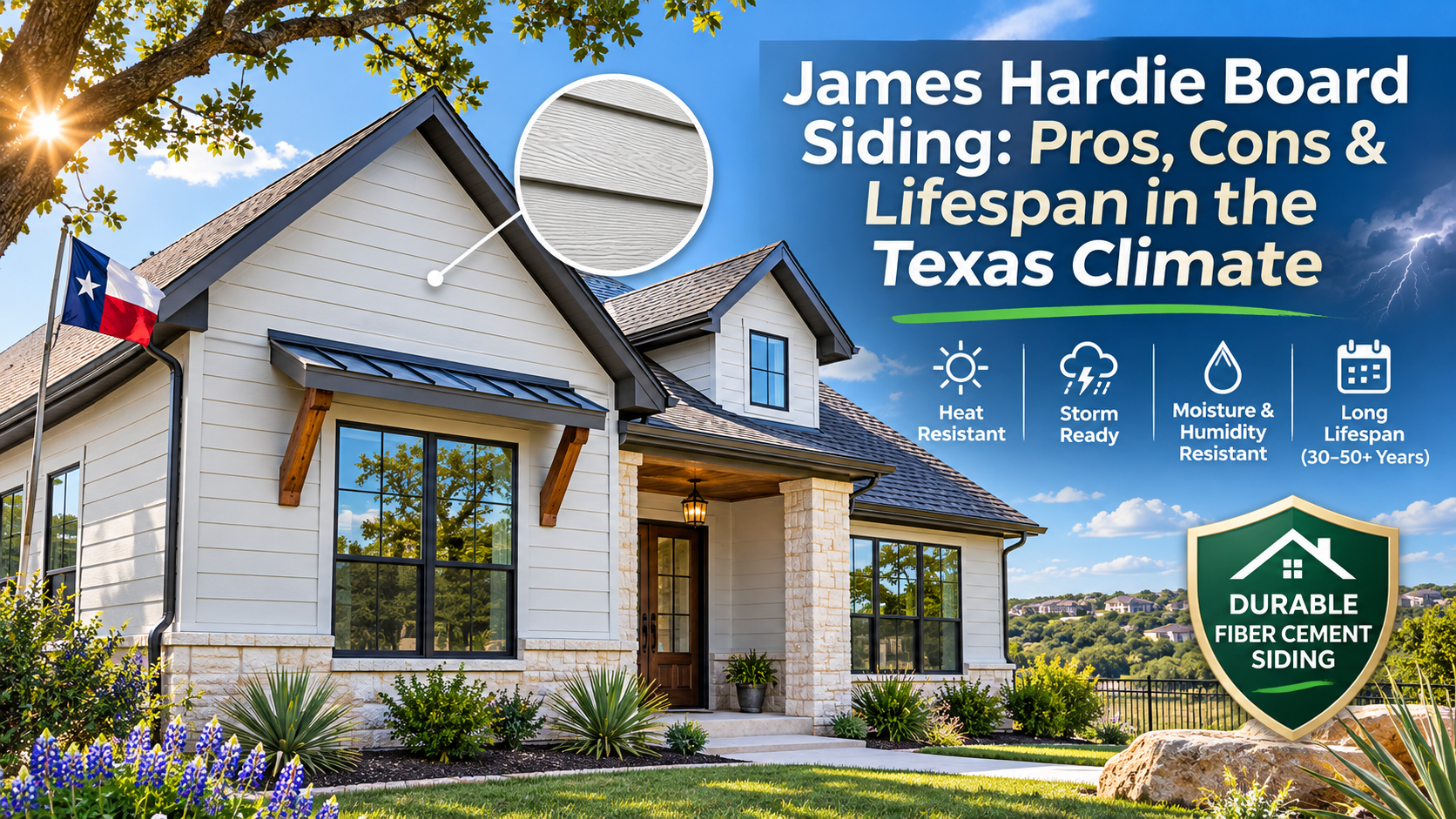
James Hardie board siding is a high-performance fiber cement exterior cladding composed of Portland cement, sand, water, and cellulose fibers. It is widely chosen across Texas because the brand’s product line is specifically engineered to endure extreme heat, UV radiation, high Gulf Coast humidity, and severe storm winds without warping or rotting.
Unlike traditional wood that absorbs moisture during torrential spring rains or vinyl that softens during 105°F August afternoons, fiber cement maintains dimensional stability across rapid temperature swings. For Texas homeowners, it delivers the crisp, authentic aesthetic of painted cedar clapboard or board-and-batten while functioning like masonry against the elements.
How long does James Hardie siding last in Texas?
Properly installed James Hardie siding lasts 30 to 50 years in Texas, while factory-applied ColorPlus Technology finishes carry a 15-year warranty against peeling, cracking, and chipping.
Key Factors That Determine Your Siding’s Lifespan in Texas
- Climate Zone Selection: Installing HZ10® (formulated for southern heat, humidity, and tropical storms) rather than HZ5® (made for northern freeze-thaw cycles) ensures maximum longevity.
- Installation Precision: Following strict clearance rules such as keeping boards at least 6 inches above soil and 1 to 2 inches above rooflines or concrete patios prevents ground-splash moisture wicking.
- Finish Type: Factory-baked ColorPlus finishes outlast field-applied exterior paint by 5 to 8 years under relentless Texas UV exposure.
- Routine Maintenance: Re-caulking window and trim joints every 5 to 7 years keeps wind-driven rain from penetrating behind the boards.
What are the biggest pros of James Hardie siding for Texas homes?
James Hardie siding excels in Texas because it directly solves the four biggest exterior threats in the Lone Star State: extreme heat, coastal moisture, destructive pests, and severe weather.
- Zero Warping or Melting in Triple-Digit Heat: Fiber cement does not soften, buckle, or distort when temperatures soar past 100°F, nor does it melt when hit by intense solar glare reflecting off modern Low-E double-pane windows.
- Resistance to Gulf Coast Humidity and Rot: In humid hubs like Houston, Beaumont, and Corpus Christi, HZ10® boards resist swelling, fungal decay, and delamination caused by salt air and heavy tropical downpours.
- Impervious to Subterranean and Formosan Termites: Because the material contains no edible wood structure, termites, carpenter ants, and woodpeckers ignore it completely.
- Non-Combustible Fire Protection: Certified under ASTM E136 as non-combustible, Hardie board will not ignite when exposed to direct flames or flying embers—a critical safeguard in wildfire-prone regions like the Texas Hill Country and West Texas.
- High Wind and Hail Resilience: Properly fastened fiber cement meets strict Texas Windstorm Insurance Association (TWIA) codes for coastal hurricane zones and withstands moderate hail impacts far better than vinyl or aluminum.
- Strong Resale Return on Investment (ROI): Remodeling data consistently shows fiber cement siding replacements recoup roughly 80% to 90% of project costs at resale while boosting curb appeal.
What are the cons and drawbacks of James Hardie siding?
The primary drawbacks of James Hardie siding are its higher upfront installation cost, heavy material weight, and periodic caulking and repainting requirements. While it outlasts budget alternatives, homeowners must plan for a larger initial capital outlay.
- Higher Upfront Price Tag: Materials and labor typically cost 2 to 3 times more than standard vinyl siding, averaging $10 to $16 per square foot installed across major Texas metros depending on home height and architectural trim complexity.
- Heavy Weight Requires Specialized Crews: Weighing roughly 2.3 to 2.5 pounds per square foot (nearly 2.5 times heavier than vinyl), the boards require multi-person crews, specialized carbide-tipped blades, and strict silica-dust safety protocols during cutting.
- Improper Installation Voids Warranties: If a general handyman nails boards too close to the edge, skips flashing behind butt joints, or leaves cut ends unsealed, moisture can seep in and void the 30-year warranty.
- Not Completely Maintenance-Free: Although it resists rot, elastomeric caulk around windows and trim dries out under the Texas sun and needs inspection every few years, and primed-only boards require repainting every 8 to 15 years.
- Vulnerability to Severe Blunt Impact: While tough against everyday wear, golf-ball-sized Texas hailstones or heavy falling oak limbs can crack or chip individual planks, requiring targeted board replacement.
James Hardie Siding vs. Vinyl Siding: Which is better for Texas?
James Hardie fiber cement is the superior choice for long-term durability, heat resistance, and home resale value in Texas, whereas vinyl siding is only better if minimizing immediate upfront cost is your top priority.
| Feature | James Hardie Fiber Cement (HZ10®) | Standard Vinyl Siding |
| Lifespan in Texas | 30–50+ years | 15–25 years |
| 100°F+ Heat & Low-E Glare | Zero warping, melting, or buckling | Can warp, sag, or melt near reflective windows |
| Hail & Wind Resistance | High (rated for coastal hurricane wind zones) | Moderate; becomes brittle and cracks in hail |
| Fire Rating | Non-combustible (ASTM E136) | Melts and burns rapidly when exposed to flame |
| Curb Appeal & Texture | Deep, authentic wood-grain or smooth architectural look | Hollow plastic sheen; “builder-grade” appearance |
| Upfront Installed Cost | Higher ($$$) | Lower ($) |
| Maintenance Needs | Annual rinse; re-caulk every 5–7 yrs; paint every 15+ yrs | Annual wash; cannot easily change faded colors |
When to Choose This or That
- Choose James Hardie if: You plan to stay in your Texas home for 7+ years, live in a hail-prone corridor (DFW), wildfire zone (Austin/Hill Country), or coastal windstorm zone (Houston/Galveston), or want maximum appraisal value.
- Choose Vinyl Siding if: You are renovating a budget rental property, flipping a starter home with tight upfront cash constraints, and live in a sheltered neighborhood away from intense Low-E window glare.
Real-Life Texas Scenarios: How Hardie Board Performs in the Field
Seeing how fiber cement holds up across Texas’s distinct microclimates illustrates why installation details matter just as much as the material itself.
- The Suburban DFW Low-E Window Reflection Test
A homeowner in Frisco, Texas, replaced aging builder-grade siding on the west-facing wall of their two-story home after intense afternoon sunlight reflecting off a neighbor’s energy-efficient Low-E windows warped their old vinyl planks into wavy ripples. The wall endured five consecutive summers of 105°F+ heat and concentrated solar reflection with zero distortion, zero fading, and no expansion gaps.
- The Houston Coastal Humidity & Storm Surge Reality
In Katy, Texas, a 1990s home suffered severe bottom-edge rot on its original pine siding due to heavy spring downpours, sprinkler overspray, and 90% summer humidity. A certified contractor stripped the rotted wood, installed a breathable weather-resistive barrier, and siding leaving a strict 2-inch clearance above the concrete driveway and 6 inches above flowerbeds. Through multiple tropical storm seasons and Formosan termite swarms in the surrounding neighborhood, the boards remained rock-solid, dry, and completely untouched by pests.
- The Austin Hill Country Wildfire Buffer
In Dripping Springs, where cedar-covered hills create elevated wildfire risks during late-summer droughts, a family building a custom ranch home paired limestone. When a brush fire scorched an adjacent lot, flying embers landed against the home’s exterior eaves and siding. Because fiber cement is non-combustible, the boards did not ignite or feed the flames, giving local firefighters crucial time to contain the perimeter without structural loss.
How do you maintain James Hardie siding in Texas?
Maintaining James Hardie siding requires less than two hours of simple visual checks and gentle cleaning per year. Following a quick seasonal checklist preserves both your home’s appearance and your 30-year warranty.
- Rinse Twice a Year: Use a standard garden hose and a soft-bristle brush with mild dish soap to wash away West Texas dust, cedar pollen, and Gulf Coast mildew. Never use a high-pressure washer above 1,500 PSI, which can etch the finish.
- Redirect Lawn Sprinklers: Adjust irrigation heads so they do not spray directly onto lower siding planks daily, preventing mineral staining and premature caulk breakdown.
- Inspect Caulking Every Spring: Check vertical trim joints and window perimeters for sun-baked cracks, and re-seal gaps using a high-grade, permanently flexible polyurethane or elastomeric exterior caulk.
- Keep Mulch and Shrubs Trimmed Back: Maintain a clear 6-inch air gap between soil or mulch beds and the bottom edge of your siding, and trim bushes at least 12 inches away so air circulates freely after rainstorms.
- Clean Gutters Before Storm Season: Ensure downspouts and kick-out flashing divert roof runoff away from walls so water never cascades behind the siding boards.
Is James Hardie siding worth the investment for Texas homeowners?
Yes, for most Texas homeowners, James Hardie siding is one of the smartest exterior investments available. While you will pay more upfront than vinyl or engineered wood, eliminating termite damage, wood rot, heat warping, and frequent 5-year repainting cycles saves thousands of dollars over a 30- to 50-year lifespan. As long as you hire an experienced contractor who follows clearance and flashing standards, your home gains decades of storm-ready protection and lasting curb appeal.
Final Takeaway: Protecting Your Texas Home for Decades
Choosing the right siding in Texas isn’t just about curb appeal it is about defending your biggest investment against triple-digit summers, Gulf Coast humidity, hailstorms, and pests. While James Hardie fiber cement requires a higher upfront budget than vinyl or engineered wood, its 30- to 50-year lifespan, non-combustible fire rating, and unmatched resistance to heat and rot deliver superior long-term value and peace of mind.
Ready to Upgrade Your Home’s Exterior?
Don’t leave your home exposed to another brutal Texas summer or storm season. Whether you are replacing warped vinyl, repairing hail damage, or planning a full exterior makeover, our Texas siding specialists are ready to help.
- Get a Free, No-Obligation Estimate: Find out the exact cost for your home’s square footage and architectural style.
- Explore ColorPlus® Samples: See how fade-resistant Hardie textures and colors look in natural Texas sunlight.
- Schedule a Free Exterior Inspection: Let our certified installers check your current siding for hidden moisture, heat damage, or caulking failures.
Request Your Free Texas Siding Quote Today → or call us at +1 (305) 967-4971 to book your in-home consultation